Signum Function
Definition
The signum function is defined by
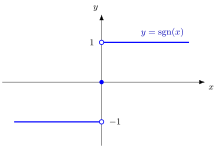
Interpretation
The signum function keeps only the sign of a real number and discards its size: every positive number goes to , every negative number to , and to . The formula shows the link with the absolute value: dividing a nonzero number by its magnitude leaves only its direction on the real line.
Read the other way, every real number factors as , sign times magnitude, and this also holds at . The three possible values match the trichotomy of real numbers: each is positive, zero or negative.
The signum function is the standard example of a jump. Its one-sided limits at are from the right and from the left, so the limit at does not exist and no choice of makes the function continuous there. It also shows why the intermediate value theorem needs continuity: on it never takes the value .
A common slip is to use at . That quotient is undefined at , which is why the definition sets separately.
Key Results
- The signum function takes values in
- It reflects the trichotomy of real numbers.
- The function is discontinuous at zero.
Examples
Prerequisites
Related Concepts
Sources
- Math I: Calculus · Lecture 5
Aliases: sign function, sgn Symbols: real numbers
Last updated: 22 October 2026 19:04
Signum FunctionFunctionLimit at a PointOne-Sided Limit