Indicator Function
Definition
The indicator function is a function that identifies whether an element of a set satisfies a given property. It is denoted as and defined as:
Interpretation
An indicator function encodes set membership as a number: it answers the question "is in ?" with for yes and for no.
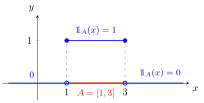
Here . The graph is at height above and at height everywhere else, so it jumps at the two endpoints. The filled dots at and show that the endpoints belong to and receive the value .
Set operations become arithmetic on the values. For all sets and ,
and ; each identity is checked by going through the four cases of whether lies in and in . In probability the same idea returns as the indicator random variable, which is when an event occurs and otherwise.
Key Results
- Indicator functions take only the values and
- Set operations can be translated into algebraic relations between indicator functions.
- Indicator functions are widely used in integration and probability.
Examples
- for and otherwise.
- distinguishes rational from irrational numbers.
Prerequisites
Related Concepts
Sources
- Math I: Calculus · Lecture 4
Aliases: characteristic function of a set Symbols: element of, intersection, rational numbers, union
Last updated: 20 October 2026 03:02
Indicator FunctionDirichlet FunctionFunctionSignum FunctionIndicator Random Variable