Intermediate Value Theorem
Theorem
Let be real numbers, and let be continuous. If is any number between and , then there exists such that
Interpretation
The intermediate value theorem makes precise the picture that the graph of a continuous function on an interval can be drawn without lifting the pen: to get from height to height , the graph has to pass through every height in between.
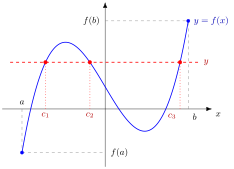
Every level between and is reached by the continuous : here at three points of . The theorem promises at least one such point; it says nothing about how many there are or where they lie.
Slide the level between and : the continuous cubic always reaches it, sometimes at several points . The function with a jump skips a whole range of levels.
Both hypotheses are needed. Continuity rules out jumps: the signum function on takes the values and but never the value . The domain must also be a whole interval without gaps: is continuous on with removed and takes the values and , but never the value .
The theorem is mostly used in its sign-change form from the Examples: if and have opposite signs, then has a zero in . It proves that an equation has a solution without solving it, and repeatedly halving the interval while keeping the sign change locates that solution numerically. Math III later extends the theorem beyond intervals.
Key Results
- Every value between and is attained on
- The theorem ensures existence but not uniqueness.
- Continuity is essential for the result.
Examples
Prerequisites
Related Concepts
Sources
- Math I: Calculus · Lecture 5
Aliases: IVT Keywords: Bolzano's theorem Symbols: element of, real numbers
Last updated: 20 October 2026 03:02
Intermediate Value TheoremContinuityMinimum of a SetMaximum of a SetConnected and Disconnected SetsIntermediate Value Theorem on Connected Sets