Euler's Number
Definition
Euler's number is defined by the standard sequence limit
which is an irrational number approximately equal to
Interpretation
Euler's number arises naturally from processes involving continuous growth. If an amount grows by per period and the growth is credited times per period, each time by a fraction of the current amount, the amount is multiplied by ; the definition lets .
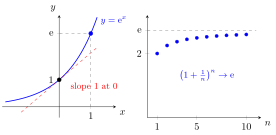
The right panel shows the defining sequence: equals for , for and about for . The terms increase towards , but slowly: crediting more often helps less and less, and the result stays below . The left panel looks ahead to the curve , which passes through with slope , touching the line there, and reaches the height at .
Increase and watch creep up towards , slowly. Switch to to see the whole curve approach .
A common slip is to take the limit of the base first: and , which suggests the limit . This is wrong because the base and the exponent change together. The limit laws cover sums, products and quotients of convergent sequences, so they give for a fixed exponent , but they say nothing about a power whose exponent grows with . Later, becomes the base of the exponential function and of the natural logarithm, and it appears in probability, for example in the Poisson distribution.
Key Results
- Euler’s number is irrational; Math I: Calculus uses this fact without proving it.
- The natural exponential function is defined using
- In Math I: Calculus, this limit is used as the definition of proving that the defining sequence converges is optional.
Examples
Prerequisites
Related Concepts
Sources
- Math I: Calculus · Lecture 3
Aliases: e, Napier's constant, base of the natural logarithm, base of the natural exponential Symbols: infinity
Last updated: 20 October 2026 03:02
Euler's NumberExponential FunctionLimit of a SequenceEuler's FormulaEuler's IdentityIrrational NumberMonotone Convergence Theorem