Identity Function
Definition
Let be a set. The identity function on is the function defined by for all That is, a function that always returns its input (argument) unchanged.
Interpretation
The identity function is the function that does nothing: it returns every input unchanged. It matters because it plays the role for composition that the number plays for multiplication.
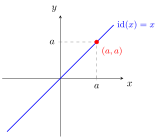
The graph of the identity on is the diagonal line : the marked point has equal coordinates. Reflecting the graph of a bijection in this line gives the graph of its inverse.
For , composing with the identity on either side changes nothing: and . This is why inverses are described by and ; the subscript matters, since for these are two different functions. In Math II the identity returns as the identity matrix, which leaves every vector unchanged.
Key Results
- Composing any function with the identity function leaves it unchanged.
- The identity function is bijective, and it is its own inverse.
Examples
- For any
- For a bijection we have and
Prerequisites
Related Concepts
Sources
- Math I: Calculus · Lecture 4
Aliases: identity map, identity mapping Symbols: element of, real numbers
Last updated: 20 October 2026 03:02
Identity FunctionDifferentiation RulesLeft and Right InversesFunctionComposition of FunctionsBijection and Inverse Function