Second-Order Condition
Proposition
Let be real numbers, and let be a function which is twice-differentiable at its stationary point Then is a local maximum point of if and it is a local minimum point of if
Interpretation
The second-order condition decides what kind of stationary point is from the sign of . At a stationary point the tangent is horizontal; means that the graph bends downwards there, giving a local maximum, and means that it bends upwards, giving a local minimum.
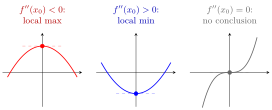
The left and middle panels show the two decisive cases: a downward parabola with a local maximum and an upward one with a local minimum. In the right panel, has and no extremum at ; the function has the same values and a minimum. So gives no conclusion either way.
The figure marks every stationary point and its sign of . The example has , so the condition is silent there, as are and at , one without and one with an extremum.
The reason lies in the sign of near . Since , the difference quotient of is , and it tends to . If , then close to we have on the left and on the right, so decreases and then increases: a local minimum. The condition only applies at stationary points, found with the first-order condition; a positive second derivative at a point where says nothing about extrema.
The conclusion is local. If on the whole interval, is strictly convex, and a stationary point is the global minimum. A common slip is to read the condition backwards: a local minimum does not force , as shows; what does hold at a local minimum of a twice differentiable function is . Math IV extends the test to functions of several variables in the conditions for unconstrained extrema.
Key Results
- A negative second derivative indicates local maximality.
- A positive second derivative indicates local minimality.
- A zero second derivative indicates that further analysis is needed.
- The condition is sufficient but not necessary.
Examples
- The function has three stationary points and We plug and in to find and Then, we conclude that and are local maximum points. The condition gives no conclusion at but directly for so is a local minimum point.
Prerequisites
Related Concepts
Sources
- Math I: Calculus · Lecture 9
Aliases: SOC, second order condition, second-order sufficient condition Keywords: second derivative test Symbols: element of, real numbers, square root
Last updated: 20 October 2026 03:02
Second-Order ConditionFirst-Order ConditionHigher-Order DerivativeConvexity and ConcavityLocal Extremum