Zero of a Function
Definition
A zero of a function (also called a root or -intercept) is any input value that makes the function's output equal to zero.
Interpretation
A zero of is an input at which the output is exactly , so finding the zeros means solving the equation . Graphically, a zero is where the function's graph crosses or touches the -axis.
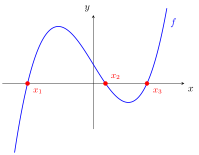
The zeros of are the -intercepts of its graph: for . These zeros, approximately , and , are not easy to find by hand. The values , , , and change sign on , on and on , and the figure shows the graph crossing the axis once in each of these intervals.
Shift the graph with and count the zeros: three crossings become a touch and then a single crossing. At a touching zero the graph meets the -axis without crossing it.
A zero is an element of the domain, a number , not a point of the plane: the zeros of are the numbers and , while the graph meets the axis at the points and . Solving is the same as finding the zeros of , so every equation in one unknown can be written as a zero problem.
A common slip concerns quotients. A zero of the denominator is not a zero of the function: is not defined at , and it has no zeros at all, since has no solution. Later, the intermediate value theorem turns the sign changes above into a proof that a zero exists.
Key Results
- A zero of a function is a solution to the equation
Examples
- The zeros of the quadratic polynomial are and
- The function does not have any zeros.
Prerequisites
Related Concepts
Sources
- Math I: Calculus · Lecture 4
Aliases: root of a function, x-intercept Keywords: root
Last updated: 20 October 2026 03:02
Zero of a FunctionRoot of a PolynomialEquilibrium of a Differential EquationFunctionGraph of a FunctionSingularityFundamental Theorem of AlgebraStationary Point