Arithmetic Series
Definition
Let be a sequence of real numbers defined by where This is known as an arithmetic sequence/progression and is called the common difference. The (finite) arithmetic series formula is given by
Interpretation
An arithmetic series is the sum of equally spaced terms: each term is the previous one plus the common difference . Its closed form gives the sum without adding the terms one by one.
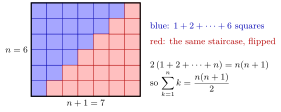
Two copies of the staircase , one blue and one red and turned around, fill a rectangle of squares, so . The same picture works for every : twice the sum is .
The trick behind the figure gives the general formula. Writing the sum forwards and backwards and adding term by term pairs the first term with the last, the second with the second-to-last, and so on, and every pair has the same sum . There are pairs, so the series equals times the average of its first and last terms. The formula can also be proved by mathematical induction.
Sums of this kind appear in Riemann sums: with equal pieces and right endpoints, the Riemann sum of on is , which tends to . An infinite arithmetic series diverges unless , because its terms do not tend to .
A common slip is an off-by-one count. The -th term is , not , and a sum from to has terms.
Key Results
- The sum of a finite arithmetic sequence can be expressed using only the first term, the common difference, and the number of terms.
- Arithmetic series grow quadratically in the number of terms when the common difference is nonzero.
Examples
Prerequisites
Related Concepts
Sources
- Math I: Calculus · Lecture 10
Keywords: arithmetic progression Symbols: element of, real numbers, sum
Last updated: 22 October 2026 19:04
Arithmetic SeriesFinite SeriesGeometric SeriesMathematical Induction