Codomain
Definition
If the function is the codomain of is the specified set in which every output must lie. The range is always a subset of the codomain, but the two sets need not be equal.
Interpretation
The codomain is the set that a function declares as the place where its outputs live. It is part of the specification , together with the domain and the rule, and is usually chosen as a large, convenient set such as .
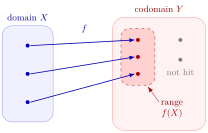
In the figure, the three points of are sent into , but only three points of are hit. They form the range , the smaller box inside ; the grey points belong to the codomain but are not values of .
The codomain is chosen, while the range follows from the rule and has to be worked out. A function is surjective exactly when its range is the whole codomain, so changing the codomain can change surjectivity without changing any value: is not surjective as a map from to , since is never reached, but it is surjective onto . This matters for a bijection, whose inverse must be defined on the whole codomain.
A common slip is to call the codomain the set of values of , which is the range. The sine function from to has codomain , but its range is .
Key Results
- The range of a function is always a subset of its codomain.
- Changing the codomain can affect whether a function is surjective.
Examples
- For defined as the codomain is
- Strictly speaking, the same formula with codomain defines a different function.
Prerequisites
Related Concepts
Sources
- Math I: Calculus · Lecture 4
Aliases: target set Symbols: infinity, real numbers
Last updated: 20 October 2026 03:02
CodomainSurjective FunctionImage and Preimage of a SetFunctionDomainRange and ImageRandom Variable