Bounded Set
Definition
A set is said to be bounded if there exists a real number such that i.e., this set can be contained within a bounded interval. A set that is not bounded is referred to as an unbounded set.
Interpretation
A bounded set consists of elements that all lie within some finite distance of : one number satisfies for every . The set does not reach arbitrarily far in either direction.
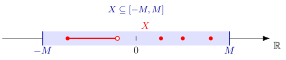
The set in the figure is made of an interval and three isolated points, yet all of it lies inside the shaded . A bounded set need not be an interval; it only has to fit inside one.
Bounded means bounded above and bounded below: if , then with , so the centre in the definition is only a convenience. A nonempty bounded set has a supremum and an infimum, but not necessarily a maximum or a minimum: has neither.
A common slip is to confuse bounded with finite. Every finite set is bounded, but and are infinite and still bounded, while is unbounded although each of its elements is an ordinary finite number.
Key Results
- Every bounded set is contained in a bounded interval.
- Every bounded interval is a bounded set.
- Every finite set is bounded.
Examples
- The set is bounded.
- is not bounded.
Prerequisites
Related Concepts
Sources
- Math I: Calculus · Lecture 4
Symbols: element of, natural numbers, rational numbers, real numbers, subset
Last updated: 20 October 2026 03:02
Bounded SetEndpoint and Bounded IntervalCompact SetBounded FunctionBounded Set in a Metric SpaceInfimumLower BoundSupremumUpper Bound