Local Extremum
Definition
Let be a function defined on a domain A point is a local maximum point (aka relative maximum point) of if there exists some such that for all with Similarly, is a local minimum point (aka relative minimum point) of if there exists some such that for all with
Interpretation
A local extremum is a point where a function attains a maximum or minimum relative to nearby values: the comparison is made only with the points of the domain within some distance , not with the whole domain. It captures optimal behaviour in a neighbourhood rather than globally.
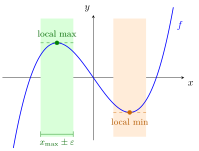
The figure shows , with a local maximum at , where , and a local minimum at , where . Inside each shaded strip of half-width , the marked value is the largest, respectively the smallest, value of . Neither is global: for and for .
Grow the neighbourhood radius : the comparison only has to hold for within of the point, not on the whole domain. A local extremum only needs one that works.
The definition only asks for some , and a smaller can only make the comparison easier. The inequality is not strict, so a constant function has a local maximum and a local minimum at every point. Only points of the domain are compared, which is why an endpoint can be a local extremum: on has a local minimum at , although its one-sided derivative there is .
Every global extremum is a local one, but not conversely. To find local extrema at interior points, one first lists the critical points with the first-order condition and then checks each of them by comparing nearby values. The definition returns in Math IV for functions of several variables as a local maximum or minimum.
Key Results
- Under this definition a local extremum may occur at an interior point or at a boundary point of the domain. The first-order condition applies only to interior points where is differentiable; boundary points must be examined separately.
- Local extrema need not be global.
- Critical points are candidates for local extrema.
Examples
- The function has a local minimum at
- The function has no local extremum.
Prerequisites
Related Concepts
- Global Extremum
- Critical Point
- Convexity and Concavity
- Inflection Point
- Rolle’s Theorem
- Second-Order Condition
- Stationary Point
Sources
- Math I: Calculus · Lecture 6
Aliases: relative extremum Keywords: local maximum, local minimum, turning point Symbols: element of, epsilon, real numbers, subset
Last updated: 20 October 2026 03:02
Local ExtremumFirst-Order ConditionLocal Maximum and Minimum on \(\mathbb{R}^n\)FunctionGlobal ExtremumCritical PointConvexity and ConcavityInflection PointRolle’s TheoremSecond-Order ConditionStationary Point