Local Maximum and Minimum on 
Definition
Let , let , and let .
- is a local maximum if there is a neighbourhood of such that for all .
- is a local minimum if there is a neighbourhood of such that for all .
The extremum is strict if the inequality is strict for all nearby feasible points other than .
Interpretation
A local extremum is best only against nearby feasible alternatives. It may or may not be globally best.
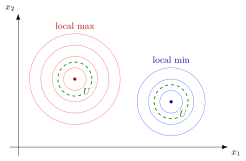
The red level sets decrease in value as one moves away from the local maximum, while the blue ones increase away from the local minimum. Only nearby feasible points in are compared. An interior local extremum of a function is stationary, but the Hessian may be inconclusive when it is semidefinite.
The marked critical points are classified by their Hessians: with the colours of the legend for minima, maxima and saddles.
Marked points are critical points, classified by the Hessian; move onto one and the tangent plane becomes horizontal.
An open metric ball can specify the neighbourhood: choose a radius and compare the candidate only with feasible points less than away. Intersecting the ball with the feasible set also covers candidates on its boundary.
Key Results
- Interior local extrema of differentiable unconstrained problems must satisfy a first-order necessary condition.
- Second-order conditions use the Hessian to classify critical points when possible.
- Local extrema need not be unique and need not be global.
Examples
- For , is a strict local minimum.
- For , is a local maximum and is a local minimum.
Prerequisites
Related Concepts
Sources
- Math IV: Multivariate Calculus · Week 4, Lecture 1
Keywords: local maximum, local minimum, local maximizer, local minimizer, relative extremum Symbols: element of, intersection, real numbers, subset
Last updated: 17 October 2026 21:53
Local Maximum and Minimum on \(\mathbb{R}^n\)Local ExtremumOpen Metric BallGlobal Maximum and Minimum on \(\mathbb{R}^n\)Unconstrained Extrema Conditions