Jacobian Rank Local Behaviour Theorem
Theorem
Let be continuously differentiable near , and write for its Jacobian matrix at .
If and , then is locally injective near .
If and , then is locally surjective near .
If and , then is locally bijective near .
Interpretation
Full rank of the Jacobian tells which local behaviour survives under linearization: no collapsing for full column rank, no missing nearby outputs for full row rank, and a local inverse in the square case.
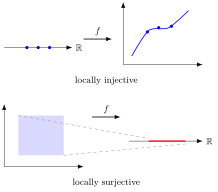
In the top example, and . Distinct nearby inputs have distinct images, illustrating local injectivity.
In the bottom example, and . The map covers a whole interval of nearby target values, illustrating local surjectivity.
Local injectivity and surjectivity describe neighbourhoods, rather than the entire domain and codomain. Full column rank prevents nearby inputs from sharing an output; full row rank permits every sufficiently nearby output to be reached.
Key Results
- The square case is the multivariable inverse function theorem.
- Full column rank gives a locally one-to-one parametrized surface or curve.
- Full row rank means nearby target values can be reached by nearby inputs.
Examples
- For , has rank , so the curve is locally injective.
- For , has rank , so the map is locally surjective onto .
Prerequisites
Related Concepts
Sources
- Math IV: Multivariate Calculus · Week 3, Lecture 1
Aliases: Jacobian Rank Local Behavior Theorem Keywords: Jacobian rank theorem, full rank local injectivity, full rank local surjectivity Symbols: real numbers, subset
Last updated: 17 October 2026 21:53
Jacobian Rank Local Behaviour TheoremJacobian MatrixRankLocal Injectivity, Surjectivity, and BijectivityMultivariable Inverse Function TheoremOpen Metric Ball