Binding and Nonbinding Constraints
Definition
For an inequality constraint written as , the constraint is binding at a feasible point if
It is nonbinding or slack at if
The same idea applies to constraints written in other equivalent sign conventions.
Interpretation
A binding constraint is tight at the chosen point. A nonbinding constraint still has room left and does not directly limit the current choice.
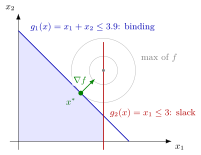
At the illustrated optimum, binds and has multiplier , while is slack and has . In this example, relaxing the first constraint increases the maximum, whereas relaxing the second does not change it.
The constraint is binding when the optimum lies on the line and slack when the peak is already feasible.
The function evaluates the constrained quantity at the chosen point. Comparing that value with through the defining inequality distinguishes equality at the boundary from strict slack inside the allowed region.
Key Results
- Only binding inequality constraints can carry nonzero multipliers in standard Kuhn-Tucker conditions.
- The set of binding constraints is often called the active set.
- Changing a nonbinding constraint slightly usually does not change the optimum locally.
Examples
- If and the optimum has , the constraint is binding.
- If and the chosen point is , the constraint is nonbinding because .
Prerequisites
Related Concepts
- Complementary Slackness
- Method of Lagrange for Inequality-Constrained Maximization
- Lagrange Multiplier
- Constraint
Sources
- Math IV: Multivariate Calculus · Week 5, Lecture 1
Aliases: active and inactive constraints, inactive constraint, tight constraint Keywords: binding constraint, nonbinding constraint, slack constraint, active constraint Symbols: lambda
Last updated: 17 October 2026 21:53
Binding and Nonbinding ConstraintsComplementary SlacknessInequalityFunctionMethod of Lagrange for Inequality-Constrained MaximizationLagrange MultiplierConstraint