Method of Lagrange for Mixed Constraints
Theorem
Let be open, and let the objective and all constraint functions be continuously differentiable on . Consider
The course convention defines
If is a local constrained maximizer and the binding inequalities are indexed by , then either
or there exist multipliers satisfying stationarity, complementary slackness, inequality feasibility, equality feasibility, and .
Interpretation
Mixed problems combine exact equations with one-sided restrictions. The first-order candidate conditions combine equality stationarity with inequality sign and slackness rules.
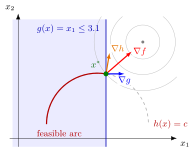
The illustrated feasible arc satisfies and . Both constraints bind at , where the objective gradient is a combination of the active constraint gradients with the appropriate multiplier signs. The theorem above specifies the normalization and regularity requirements for the multipliers.
The equality-constraint method contributes unrestricted multipliers for the equalities. The inequality-constrained maximization method contributes nonnegative multipliers and complementary slackness for the inequalities. Both kinds enter the same stationarity equation.
Key Results
- Only inequalities require nonnegative multipliers.
- Only binding inequalities are included in the active NDCQ matrix.
- All equality constraints must hold exactly.
Examples
- For subject to and , the method uses one nonnegative multiplier and one unrestricted multiplier.
- If an inequality is nonbinding at the solution, its multiplier is zero and it is not part of the active rank test.
Prerequisites
- Method of Lagrange for Inequality-Constrained Maximization
- Method of Lagrange for Equality Constraints
Related Concepts
Sources
- Math IV: Multivariate Calculus · Week 5, Lecture 2
Aliases: Lagrange method with mixed constraints Keywords: mixed constraints, mixed-constraint FONC, KKT conditions with equalities Symbols: element of, lambda, mu, real numbers, subset, sum
Last updated: 22 October 2026 19:04
Method of Lagrange for Mixed ConstraintsGeneral Method of LagrangeMethod of Lagrange for Constrained MinimizationSecond-Order Sufficient Conditions for Constrained OptimizationMethod of Lagrange for Inequality-Constrained MaximizationMethod of Lagrange for Equality ConstraintsNondegenerate Constraint Qualification