General Method of Lagrange
Theorem
Let be open, and let be continuously differentiable on . For minimization, write the inequalities as ; for maximization, write them as . With equalities , define the generalized Lagrangian
If is a local constrained optimum, then there exist multipliers with , , and such that stationarity, feasibility, and complementary slackness hold.
Interpretation
This method avoids a separate regularity check by adding a multiplier on the objective itself. The extra case captures points where the active constraints are degenerate.
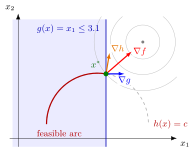
The illustrated feasible arc satisfies and . Both constraints bind at , where the objective gradient is a combination of the active constraint gradients with the appropriate multiplier signs. The theorem above specifies the normalization and regularity requirements for the multipliers.
The mixed-constraint method is recovered when the objective multiplier can be normalized to one. The nondegenerate constraint qualification rules out an abnormal candidate with zero objective multiplier: independence of the active constraint gradients would then force every multiplier to vanish.
Key Results
- If , the regular first-order necessary conditions are recovered.
- If , the condition signals linear dependence among active constraint gradients.
- The method keeps nonregular feasible points inside the theorem.
Examples
- For a regular optimum, choosing gives the usual Lagrangian conditions.
- If active constraint gradients are linearly dependent, a solution may appear with and nonzero constraint multipliers.
Prerequisites
Related Concepts
Sources
- Math IV: Multivariate Calculus · Week 7, Lecture 1
Aliases: Fritz John conditions, Fritz John theorem Keywords: generalized Lagrange method, objective multiplier method, Lagrange method without checking NDCQ Symbols: element of, lambda, mu, real numbers, subset, sum
Last updated: 22 October 2026 19:04
General Method of LagrangeNondegenerate Constraint QualificationMethod of Lagrange for Mixed ConstraintsKuhn-Tucker Conditions with Nonnegativity ConstraintsLagrange Multiplier