Independent Linear Constraint System
Definition
A linear constraint system
with has independent constraints if the rows of are linearly independent, equivalently
For nonlinear equality constraints , the corresponding local condition at is that the gradients are linearly independent.
Interpretation
Independent constraints each remove a genuinely new direction. Dependent constraints repeat information and can make multiplier tests misleading.
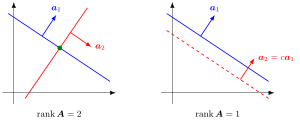
On the right, the rows of are dependent and . The corresponding parallel lines either have no common solution or coincide along a whole line. On the left, the two independent constraints have rank and meet at one point.
The rank counts independent rows. Equality to means that no constraint equation is an algebraic consequence of the others; for nonlinear constraints the same check applies to their gradients at the chosen point.
Key Results
- For independent equality constraints in , the linearized feasible directions (the null space of the constraint matrix or Jacobian) form an -dimensional space, by the rank-nullity theorem.
- Independence is a rank condition on the constraint Jacobian.
- Nondegenerate constraint qualification is the nonlinear optimization version of this idea.
Examples
- The constraints and are dependent because the second repeats the first.
- The constraints and are independent because the matrix has rank .
Prerequisites
Related Concepts
Sources
- Math IV: Multivariate Calculus · Week 3, Lecture 2
Aliases: independent constraints Keywords: independent linear constraints, linearly independent constraints, constraint rank Symbols: element of, nabla gradient, real numbers
Last updated: 17 October 2026 21:53
Independent Linear Constraint SystemQuadratic Form on a Constraint SetRankGradientMatrixNondegenerate Constraint QualificationBordered Matrix Test