Nondegenerate Constraint Qualification
Definition
Write the constraint map as . For equality constraints , the nondegenerate constraint qualification is satisfied at if
With inequality constraints, the same rank condition is applied to the gradients of the binding inequality constraints together with the equality constraints.
Interpretation
NDCQ says the active constraints are locally independent. If it fails, some constraint may be redundant or the feasible set may have a singular shape.
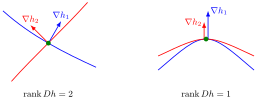
On the left, the constraints cross transversally and , so the qualification holds. On the right, they touch with parallel gradients and , so it fails.
The Jacobian collects the constraint gradients as rows. Its rank equals the number of active constraints exactly when these rows are independent, excluding a nonzero linear relation between their first-order effects.
Key Results
- When NDCQ holds, the regular Lagrange necessary conditions apply at a constrained local optimum.
- If NDCQ fails, the point remains a candidate that must be checked separately.
- For inequality problems, nonbinding inequalities are not included in the active rank check.
Examples
- For , NDCQ holds at every point because the gradient is nonzero.
- For and , NDCQ fails because the gradients are dependent.
Prerequisites
Related Concepts
Sources
- Math IV: Multivariate Calculus · Week 4, Lecture 2
- Math IV: Multivariate Calculus · Week 5, Lecture 1
- Math IV: Multivariate Calculus · Week 5, Lecture 2
Aliases: NDCQ, LICQ Keywords: constraint qualification, active constraint rank condition, linear independence constraint qualification
Last updated: 26 October 2026 00:09
Nondegenerate Constraint QualificationGeneral Method of LagrangeMethod of Lagrange for Equality ConstraintsMethod of Lagrange for Inequality-Constrained MaximizationRankJacobian MatrixMethod of Lagrange for Mixed Constraints