Bordered Matrix Test
Theorem
Let with symmetric, and let the independent linear constraint set be with and . The bordered matrix is
Ignore the first leading principal minors. For :
- If for all relevant , then is positive definite on the constraint set.
- If for all relevant , then is negative definite on the constraint set.
Interpretation
The bordered matrix test checks the sign of a quadratic form only along the directions that linear constraints leave free (definiteness on the constraint set). It is the constrained version of Sylvester's criterion, again read from determinant signs.
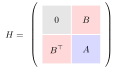
The figure shows the blocks of : an zero block (grey), the constraint matrix and its transpose as a border (red), and the matrix of the form (blue). is the top-left submatrix. The first leading minors do not depend on , which is why they are ignored; the remaining are as many as the dimension of the constraint set .
With one constraint in two variables, the sign of decides definiteness on the constraint set, matching the sign of the form along the highlighted line .
For on the line from the Examples, and , so and ; indeed for .
The rank condition says that the constraints are independent, so they remove exactly directions. Without it the test breaks down: if the rows of are dependent, some has , then sends to , and whatever is.
A common slip is to expect positive determinants for a positive definite form. With one constraint, positive definiteness on the constraint set shows up as negative minors, as in the example; the factor tells which sign to look for. The test returns later in the course, with a Lagrangian's Hessian as , as the bordered Hessian.
Key Results
- Definiteness on the whole space can change after restricting to a constraint set.
- For positive definiteness, all relevant signs match .
- For negative definiteness, relevant signs alternate and the full determinant has sign .
Examples
- The form is indefinite on but positive on the line .
- When and , there is just one relevant minor: gives positive definiteness of on the constraint line.
- When and , inspect and after ignoring the first two leading minors.
Prerequisites
Related Concepts
Sources
- Math IV: Multivariate Calculus · Week 3, Lecture 2
Keywords: bordered matrix, bordered determinant test, constrained definiteness test, quadratic form under constraints Symbols: element of, real numbers
Last updated: 20 October 2026 03:02
Bordered Matrix TestQuadratic FormRankPrincipal Minors and Sylvester's CriterionSecond-Order Sufficient Conditions for Constrained OptimizationSubspace