Velocity Vector of a Curve
Definition
Let be a differentiable curve, that is, a path parametrized by an interval rather than by . If each component is differentiable at , then the velocity vector of at is
The velocity is the tangent vector to the curve at the point .
Interpretation
The velocity vector records the instantaneous direction and rate of motion along a path: each component says how fast one coordinate of the position changes at time .
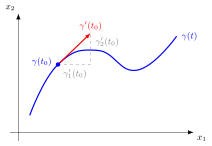
The red arrow starts at the point and touches the curve there. The dashed legs are its components and , the derivatives of the coordinate functions. Its length is the speed. If the velocity is nonzero, the tangent line is the line , .
The velocity is tangent to the curve; its components are the derivatives of the coordinates, and its length is the speed.
A curve here is a map , not only its image. The unit circle traced as has speed , traced as it has speed : same image, different velocities. The condition in the tangent statement is needed: has velocity at , and its image has a sharp point (a cusp) at the origin, so the velocity there gives no tangent direction.
For the velocity is the ordinary derivative, and in general it is the single column of the Jacobian matrix of . Combined with a gradient, it gives the rate of change of a function along the curve, the chain rule on a curve. For the straight line with unit the velocity is , and that rate at is the directional derivative .
Key Results
- Velocity is computed component by component.
- If , then gives a tangent direction to the image of the curve.
- The speed of the curve is when a norm is being used.
Examples
- For , the velocity is , so at the curve passes through with velocity .
- For , the velocity is , which is tangent to the unit circle.
Prerequisites
Related Concepts
Sources
- Math IV: Multivariate Calculus · Week 1, Lecture 2
Aliases: velocity of a curve, velocity vector Keywords: derivative of a parametrized curve, tangent vector Symbols: element of, gamma, real numbers, subset
Last updated: 20 October 2026 03:02
Velocity Vector of a CurvePath in a Metric SpaceVectorChain Rule on a CurveEuclidean NormDirectional Derivative