Kuhn-Tucker Lagrangian
Definition
For an optimization problem with equality constraints and inequality constraints , a Kuhn-Tucker Lagrangian is an expression of the form
with sign restrictions such as or depending on the maximization or minimization convention.
Interpretation
The Kuhn-Tucker Lagrangian brings the objective and all active constraint pressures into one stationarity expression.
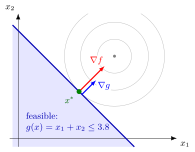
At the illustrated constrained maximum, the gradient points outwards, towards the infeasible unconstrained maximum. Writing the constraints as and using the maximization convention with , the multipliers satisfy , , and . Any slack inequality has multiplier zero.
At the optimum is a nonnegative multiple of the gradients of the binding constraints.
This extends the Lagrangian function by including inequality residuals. Their multiplier signs depend on how the residual and optimization direction are written; complementary slackness prevents a strictly slack constraint from contributing a nonzero multiplier.
Key Results
- Equality multipliers are usually unrestricted in sign.
- Inequality multipliers have sign restrictions tied to the chosen convention.
- Complementary slackness connects each inequality multiplier to whether its constraint is binding.
Examples
- For maximizing subject to , one common convention uses with .
- For a nonnegativity condition , the Kuhn-Tucker system may include a multiplier attached to that boundary condition.
Prerequisites
Related Concepts
- Kuhn-Tucker Conditions with Nonnegativity Constraints
- Method of Lagrange for Mixed Constraints
- Complementary Slackness
Sources
- Math IV: Multivariate Calculus · Week 7, Lecture 1
Aliases: KKT Lagrangian, Karush-Kuhn-Tucker Lagrangian Keywords: Lagrangian with inequality constraints Symbols: lambda, mu, nabla gradient, sum
Last updated: 22 October 2026 19:04
Kuhn-Tucker LagrangianLagrangian FunctionLagrange MultiplierInequalityKuhn-Tucker Conditions with Nonnegativity ConstraintsMethod of Lagrange for Mixed ConstraintsComplementary Slackness