Partial Jacobians
Definition
Let be differentiable, and write the variables as with and . The partial Jacobians of are the blocks
Together they form the full Jacobian:
Interpretation
A partial Jacobian isolates how an equation system responds to one chosen block of variables while the other block is held fixed. It is the matrix version of a partial derivative.
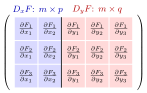
Each row of the Jacobian belongs to one component and each column to one variable. In the figure , and : the two blue columns, derivatives with respect to and , form (), and the three red columns form (). So the full Jacobian is split by columns, , never by rows.
The split matters when the two blocks play different roles. In the implicit function theorem, is exogenous and is solved for. If satisfies , the multivariable chain rule gives , so when the block is square and invertible. Square means , as many unknowns as equations, as in the figure. For the circle from the Examples this gives where ; at the block , and indeed near that point is not a function of .
A common slip is to reverse the product. is and is , so is : one row for each endogenous variable and one column for each exogenous one. In the other order the sizes do not match unless .
Key Results
- Partial Jacobians are the matrix version of holding some variables constant in partial differentiation.
- The implicit function theorem uses the partial Jacobian with respect to the variables being solved for.
- Block notation makes comparative statics formulas easier to write and remember.
Examples
- For , and .
- For , and .
Prerequisites
Related Concepts
Sources
- Math IV: Multivariate Calculus · Week 2, Lecture 2
Aliases: partial jacobian Keywords: Jacobian with respect to variables, block Jacobian Symbols: element of, real numbers, subset
Last updated: 22 October 2026 19:04
Partial JacobiansJacobian MatrixMatrixImplicit Function TheoremExogenous and Endogenous VariablesTotal Derivative as a Linear Map