Convex Set in 
Definition
A set is convex if for every and every ,
Equivalently, the whole line segment between any two points of lies inside .
Interpretation
A convex set contains, with any two of its points, the whole straight segment between them. In optimization terms: moving in a straight line from one feasible point to another never leaves the feasible region.
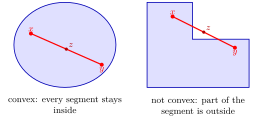
In the left set the segment from to stays inside, and is one of its points . The right set has a dent, and part of the drawn segment runs outside it. One such segment proves that a set is not convex; convexity needs every pair of points.
Drag and inside the set and move : a set is convex when every such segment stays inside. Find a segment that leaves the L-shape.
As runs from to , the point moves along the segment from to (parametric representation of a line); the two weights are nonnegative and add up to . If and , then , so a half-space is convex, and so is every intersection of half-spaces, such as the feasible region of a linear program. Unions behave differently: two disjoint discs together are not convex.
In a segment is an interval , which is why convexity of a function was defined on an interval. A convex function on needs a convex domain for the same reason: must be defined.
Convex sets need not be closed or bounded: an open ball, a half-space and itself are convex.
Key Results
- Intersections of convex sets are convex.
- Euclidean open balls, closed balls, half-spaces, and affine subspaces are convex. The same ball conclusion holds for norm-induced metrics, but not for arbitrary metrics.
- A feasible region described by linear equality and weak linear inequality constraints is convex.
Examples
- The set is convex because it is a half-space.
- The unit disk is convex, but the unit circle is not.
Prerequisites
Related Concepts
Sources
- Math IV: Multivariate Calculus · Week 4, Lecture 1
Aliases: convex set in rn, convex set Keywords: convex subset, line segment property Symbols: element of, lambda, real numbers, subset
Last updated: 20 October 2026 03:02
Convex Set in R^nConvex and Concave Functions on R^nReal Coordinate SpaceVectorGlobal Maximum and Minimum on \(\mathbb{R}^n\)Inequality