Kuhn-Tucker Conditions with Nonnegativity Constraints
Theorem
Let be open and let and the finitely many constraint functions be on . For the maximization problem
define the Kuhn-Tucker Lagrangian
Assume the nondegenerate constraint qualification holds for all active inequalities, including the active bounds : their gradients at the candidate point are linearly independent. At such a regular local maximum, there exists such that
and
Interpretation
Nonnegative variables can be either interior or stuck at the boundary. The Kuhn-Tucker conditions encode that boundary logic together with ordinary inequality slackness.
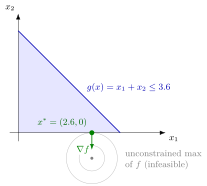
In this maximization example, gives , while gives and . The inequality is slack, so its multiplier is ; only the nonnegativity of binds. The objective would increase by moving below the -axis, but that move is infeasible.
At a corner two constraints bind at once, each with its own nonnegative multiplier.
These conditions specialize the inequality-constrained maximization method to coordinate restrictions. Treating as inequalities gives a zero derivative for a positive coordinate and a nonpositive derivative at a coordinate fixed at zero, with the stated maximization convention.
Key Results
- If , the derivative condition for that variable becomes equality.
- If a multiplier is positive, the corresponding ordinary inequality constraint is binding.
- The conditions are necessary at regular local maxima.
Examples
- If , then forces .
- If , then , so the constraint is binding.
Prerequisites
Related Concepts
Sources
- Math IV: Multivariate Calculus · Week 7, Lecture 1
Aliases: KKT conditions with nonnegativity Keywords: KT conditions, KKT conditions, Kuhn-Tucker Lagrangian, nonnegativity constraint Symbols: element of, lambda, partial, real numbers, subset, sum
Last updated: 22 October 2026 19:04
Kuhn-Tucker Conditions with Nonnegativity ConstraintsMethod of Lagrange for Inequality-Constrained MaximizationLagrange MultiplierGeneral Method of LagrangeNondegenerate Constraint Qualification