Multivariable Inverse Function Theorem
Theorem
Let be open, let be , and let with . If
then there exists an open neighbourhood of such that is bijective. The image is an open neighbourhood of . Its inverse is and
Interpretation
An invertible Jacobian makes the function locally reversible: if the linear approximation of at can be undone, so can itself near , and the inverse is again .
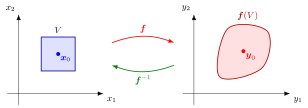
The square around is sent onto a curved region around ; every point of that region comes from exactly one point of the square. The arrow back is the local inverse, defined only on the curved region.
The determinant condition is the square full-rank condition: equations in unknowns. The hypothesis keeps the Jacobian invertible near ; differentiability alone is not enough. For with , , yet takes the values and arbitrarily close to , so is not injective on any interval around . If , the theorem is silent: has no local inverse at the origin, but has one.
Differentiating with the multivariable chain rule gives , the derivative formula of the Theorem. For it is the rule of the one-variable inverse function theorem.
The conclusion is local bijectivity of a restricted map, not a global inverse on the original domain. For from the Examples the determinant is never , yet and have the same image.
Key Results
- The determinant condition is the square full-rank condition.
- The derivative of the local inverse is the inverse matrix of the original derivative.
- The theorem can be derived from the implicit function theorem and vice versa.
Examples
- For , the determinant is , so the map is locally invertible everywhere.
- For at , the determinant is , so the theorem does not apply there.
Prerequisites
Related Concepts
Sources
- Math IV: Multivariate Calculus · Week 3, Lecture 1
Aliases: inverse function theorem in R^n, inverse function theorem in Rn Keywords: local inverse theorem, Jacobian inverse theorem Symbols: element of, pi, real numbers, subset
Last updated: 20 October 2026 03:02
Multivariable Inverse Function TheoremLocal Injectivity, Surjectivity, and BijectivityDeterminantImplicit Function TheoremInverse Function Theorem