Tensor Contraction for Taylor Terms
Definition
Let be the th derivative of a scalar function at , viewed as a -linear map. Its contraction with a displacement is
In a Taylor polynomial, the corresponding th-order contribution is
Interpretation
A derivative tensor is useful once it is evaluated on a concrete displacement. Contraction turns the stored derivative information into the actual Taylor correction in that direction.
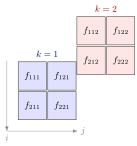
has entries (here : a cube, front , back ), symmetric under any permutation of for . Contraction with , , gives the cubic Taylor term .
The third-order derivative tensor is the case : inserting the displacement in all three slots and summing over its indices produces one scalar cubic contribution, with coefficient in the Taylor formula.
Key Results
- For , the contraction is the quadratic form .
- For , the contraction sums all third partial derivatives weighted by three components of .
- The factorial corrects for repeated counting in the Taylor expansion.
Examples
- If and , then .
- For at the origin and , the third-order contraction is .
Prerequisites
Related Concepts
Sources
- Math IV: Multivariate Calculus · Week 2, Lecture 1
Aliases: contracting derivative tensors Keywords: tensor contraction, higher-order Taylor term Symbols: element of, real numbers, sum
Last updated: 27 October 2026 11:52
Tensor Contraction for Taylor TermsThird-Order Derivative TensorQuadratic FormMultivariate Taylor ApproximationsHigher-Order Partial Derivative