Taylor Polynomial
Definition
Let be an integer and let the function be times differentiable at . The -th order Taylor polynomial of at is the polynomial
Interpretation
The -th order Taylor polynomial is the polynomial of degree at most that imitates as closely as possible near . Its coefficients are chosen so that has the same value and the same first derivatives at as : differentiating exactly times leaves the constant , which the factorial in the coefficient cancels.
Read term by term, is the constant , and is the tangent line, whose slope is the derivative . Each further term corrects what the previous ones miss, starting with the curvature. If is times differentiable at , then is the unique polynomial of degree at most with as (in little- notation); in this sense it is the best polynomial approximation of order near .
The -th order Taylor polynomial consists of the first terms of the Taylor series centred at the same point, when that series exists.
A common slip is to expect that a higher order always gives a better approximation at a fixed far from . The guarantee is local. For at , , so moves further away from as grows.
The same idea returns for functions of several variables in Math IV, in multivariate Taylor approximations.
Key Results
- The -th order Taylor polynomial and the function have the same value and the same derivatives up to order at for Away from they generally differ.
- One can write a Taylor polynomial for a function just from its first few derivatives, but the full Taylor series exists if the function is smooth, and the full series converges to the function on a neighbourhood of if and only if the function is real analytic at .
Examples
-
The 3rd order Taylor polynomial of around is .
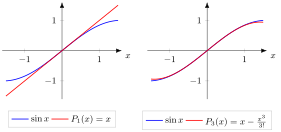
The two panels compare Taylor polynomials of about . The cubic on the right follows over a wider interval than the linear polynomial on the left.
-
The 1st order Taylor polynomial of around is .
Raise the order and move the centre : matches and its first derivatives at , and fits over a wider range.
Prerequisites
Related Concepts
Sources
- Math III: Analysis · Lecture 3
Symbols: sum
Last updated: 22 October 2026 19:04
Taylor PolynomialPolynomialTaylor's TheoremWeierstrass Approximation TheoremTaylor Series