Total Derivative as a Linear Map
Definition
Let , let be a function, let , and let be a linear transformation. We say that is (totally) differentiable at with (total) derivative if, as ,
The limit must hold however approaches , that is, along every convergent sequence with , not just along coordinate lines. It says that the relative error in the linear approximation tends to zero.
Interpretation
Total differentiability means the function can be approximated near the point by a linear transformation, with the error shrinking to zero faster than the distance to the point. The linear map is also called the differential of at ; for it is , the one-variable differential .
It is the multidimensional version of the one-variable fact that is differentiable at if and only if as (sometimes called Newton's approximation).
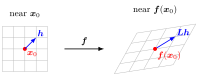
The first-order approximation is , where . Locally, acts like this linear map, so small squares become approximate parallelograms.
Move and zoom in: near the graph is almost the plane , with an error that shrinks faster than .
Key Results
- For the function at , its derivative, , is a matrix or an equivalent linear transformation from to .
- , where is an infinitesimal vector, provides an approximation of the shift in (a vector in ) arising from the change in around (a vector in ).
Examples
- The function is differentiable at with the derivative .
- The function is differentiable at and the derivative is .
Prerequisites
Related Concepts
- Directional Derivative
- Partial Derivative
- Jacobian Matrix
- Derivative and Differentiability
- Twice Continuous Differentiability on
Sources
- Math III: Analysis · Lecture 11
Aliases: total derivative, Frechet derivative, Fréchet derivative, totally differentiable Keywords: differential Symbols: element of, real numbers, subset
Last updated: 17 October 2026 21:53
Total Derivative as a Linear MapChain Rule on a CurveLinear MapConvergence in a Metric SpaceMatrixDirectional DerivativePartial DerivativeJacobian MatrixDerivative and DifferentiabilityTwice Continuous Differentiability on R^n