Heine-Cantor Theorem
Theorem
Let be real numbers, and consider a function that is continuous on Then, is uniformly continuous on
Interpretation
Continuity of at each point gives, for every , a that may depend on the point. The Heine-Cantor theorem says that on a closed bounded interval this dependence can be removed: one works at every point of at once. The function cannot become steeper and steeper towards an edge, because the endpoints belong to the interval and is continuous there as well.
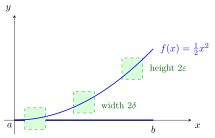
The figure takes with and . Each rectangle has width and height and is centred on a point of the graph, and the graph stays inside every rectangle over its whole width. Since on , the mean value theorem gives , so works everywhere.
Both properties of the domain matter. On the open interval the continuous function is not uniformly continuous: it becomes arbitrarily steep near the missing endpoint . On the closed but unbounded interval the function fails too: the points and are closer than , yet their values differ by , which exceeds any for large . The theorem gives a sufficient condition only, as the Examples show.
The theorem is the usual step in showing that continuous functions on are Riemann integrable: one controls the variation of on every subinterval of a partition at once.
"Uniform" does not mean that is independent of . It still depends on , only no longer on the point.
The theorem returns later with replaced by more general closed and bounded sets, the compact sets.
Key Results
- This theorem has a generalized version if is replaced by a compact set.
- This theorem does not imply that uniform continuity holds only on closed intervals.
Examples
- The function is uniformly continuous on any closed interval since we know it is continuous everywhere.
- The function is uniformly continuous on though is not a closed interval. This does not contradict the theorem since the "closed interval" condition is sufficient but not necessary.
Prerequisites
Related Concepts
- Uniform Continuity between Metric Spaces
- Uniform Continuity
- Compact Set
- Extreme Value Theorem on Compact Sets
Sources
- Math III: Analysis · Lecture 1
Symbols: delta, epsilon, infinity, real numbers
Last updated: 20 October 2026 03:02
Heine-Cantor TheoremIntervalContinuityUniform Continuity between Metric SpacesUniform ContinuityCompact SetExtreme Value Theorem on Compact Sets