Weierstrass Approximation Theorem
Theorem
For a continuous function and any there exists a polynomial such that
Interpretation
Any continuous function on a closed bounded interval can be approximated as closely as desired by a polynomial, uniformly on the whole interval: for each tolerance there is a polynomial whose graph stays within of the graph of at every point of .
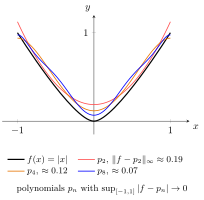
The figure approximates on , which has a corner at and is not differentiable there, by even polynomials , and . Their largest errors in the uniform norm are about , and , and in each case the largest error sits at the corner. The errors shrink as the degree grows, which is what the theorem promises.
Raise the degree of the Bernstein polynomial until it lies within of on all of , even at the kink of .
Both hypotheses are needed. A polynomial is continuous, and a uniform limit of continuous functions is continuous, so a function with a jump cannot be approximated uniformly by polynomials. The interval must be closed and bounded as well: every polynomial is bounded on , so none stays within of the unbounded function there, and on even cannot be approximated, as in the Examples.
The approximating polynomials are not partial sums of one power series. The sum of a power series is differentiable inside its interval of convergence, so is not such a sum around , yet it is a uniform limit of polynomials; in the figure even the constant term changes from one to the next. The theorem guarantees existence only; Bernstein polynomials, used in the interactive scene, are one explicit construction. It differs from the Taylor polynomials met later, which are built from derivatives at a single point.
Key Results
- Equivalently, every continuous function on is a uniform limit of polynomials: there are polynomials with in the uniform norm.
Examples
- On , the polynomials approximate uniformly: is largest at , so . For the error is .
- Continuous functions, e.g., , over the entirety of aren't always uniformly approximable by polynomials.
Prerequisites
Related Concepts
Sources
- Math III: Analysis · Lecture 2
Symbols: epsilon, infinity, real numbers, sum
Last updated: 20 October 2026 03:02
Weierstrass Approximation TheoremContinuityPolynomialUniform NormPower SeriesTaylor Polynomial