Cauchy Sequence in a Metric Space
Definition
A sequence of points in a metric space is called a Cauchy sequence if, for every , there exists an integer such that the distance for all .
Interpretation
A Cauchy sequence is one whose terms eventually all lie close to each other. It is the same idea as a Cauchy sequence of real numbers, but with the absolute value replaced by a general metric. Unlike the definition of convergence, it never mentions a limit, so it can be checked using the terms alone.
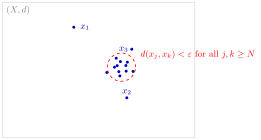
From some index on, all terms in the figure lie inside the small dashed circle, close enough that for all . The terms get closer to each other, but a Cauchy sequence need not converge to a point of unless the space is complete.
Raise until all tail points lie within of each other, without using the limit at all.
The condition concerns all pairs , not only consecutive terms. The partial sums of the harmonic series have , yet for every , so they are not Cauchy.
Every convergent sequence is Cauchy, by the triangle inequality . The converse holds exactly in complete metric spaces, such as with any -metric, and fails in , as the Examples show. Being Cauchy depends on the metric, but strongly equivalent metrics have the same Cauchy sequences, because and .
Key Results
- While all convergent sequences are Cauchy, not every Cauchy sequence converges because a sequence can cluster together (Cauchy property) around a limit that does not exist within the current space.
Examples
- Take the rational numbers with the usual metric . The sequence consists of rational numbers and converges in to , so it is Cauchy. Since is irrational, it does not converge to any point of : the space is not complete.
Prerequisites
Related Concepts
Sources
- Math III: Analysis · Lecture 4
Symbols: epsilon, infinity, rational numbers, real numbers
Last updated: 20 October 2026 03:02
Cauchy Sequence in a Metric SpaceComplete Metric SpaceMetric and Metric SpaceConvergence in a Metric SpaceCauchy Sequence