Normal Convergence
Definition
Let be a sequence of bounded functions on . We say the series is normally convergent if the series of uniform norms of the terms of the series converges, i.e.,
Interpretation
Normal convergence asks that the worst-case sizes of the terms form a convergent numerical series. Instead of studying at every , one attaches a single number to each term, its uniform norm; if these numbers are summable, the series of functions is controlled everywhere at once.
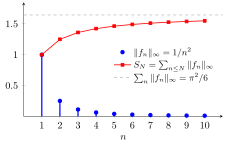
In the figure, . The bars are the norms, decreasing to , and the partial sums of the norms increase towards . Because the series of norms converges, its tail bounds the error everywhere: after terms, the partial sum of the function series differs from its limit by at most at every , less than for .
converges, so the partial sums stay within the shrinking band around the limit.
The condition involves only numbers, so it is checked with the tests for numerical series, such as comparison with a -series. Normal convergence is exactly the hypothesis of the Weierstrass -test, which turns it into uniform convergence; at each fixed it also gives absolute convergence of , since . The name refers to the norm.
The implications in the Key Results go one way only. The Examples give a series that converges absolutely and uniformly but not normally. A uniformly convergent series also need not converge absolutely: the constant functions form a uniformly convergent alternating series, while is the harmonic series. Normal convergence is a convenient sufficient condition, not a description of all uniformly convergent series.
Key Results
- Normal convergence implies uniform absolute convergence (the series converges uniformly), which in turn implies uniform convergence, which in turn implies pointwise convergence, i.e.,
Here is the sum of the absolute series; it differs from unless every
Examples
Uniform absolute convergence does not imply normal convergence. On , consider
The absolute series converges uniformly: its tail after the first terms has supremum , which tends to zero. However, , so the series of uniform norms is the harmonic series and diverges.
Prerequisites
Related Concepts
Sources
- Math III: Analysis · Lecture 2
Aliases: normally convergent Symbols: infinity, natural numbers, pi, sum
Last updated: 20 October 2026 03:02
Normal ConvergenceUniform NormInfinite Series of FunctionsWeierstrass M-test