Pointwise Convergence
Definition
Let be a sequence of functions and be another function. We say that converges pointwise to on and write if for every
Each is a Function, so fixing gives an ordinary numerical sequence . Its Limit of a Sequence is ; the required index may depend on this fixed .
Interpretation
Pointwise convergence means that for each fixed point , the numbers form an ordinary sequence that tends to as . The functions are compared with the limit one point at a time, and nothing is required about how the points relate to each other.
Written out with quantifiers: for every and every there is an such that for all . The index may depend on both and . If one can be chosen for all at once, the convergence is uniform; the two notions differ only in this order of quantifiers.
Because the required may grow without bound as moves, properties of the need not survive in the limit, as the Key Results state. The functions on are continuous, but their pointwise limit is on and at , so it is not continuous. Integrals are not preserved either: on , let on and elsewhere. Then at every , while for every .
A common slip is to let the point move with . Pointwise convergence fixes first and only then lets . For , the values tend to , not to ; this does not contradict pointwise convergence to on , but it does show that the convergence is not uniform.
The same idea returns in probability: almost-sure convergence of random variables is pointwise convergence on the sample space outside a set of probability zero.
Key Results
- Pointwise convergence guarantees that the limit exists at each individual point.
- Pointwise convergence does not preserve boundedness, limits/continuity, differentiability, or integrals.
Examples
- converges pointwise to on
- converges pointwise to
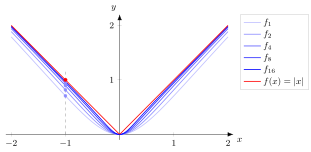
For each fixed , ; at the values (dots) increase to .
Point at a value : the numbers (right) enter the -band from some on. For that grows without bound as .
Prerequisites
Related Concepts
Sources
- Math III: Analysis · Lecture 1
Aliases: converges pointwise, pointwise limit Symbols: element of, epsilon, infinity, integral, real numbers, square root
Last updated: 20 October 2026 03:02
Pointwise ConvergenceInfinite Series of FunctionsFunctionLimit of a SequenceUniform ConvergenceConvergence in Probability