Convergence in Probability
Definition
Let and be random variables on a common probability space. The sequence converges in probability to , written , if for every ,
The Sequence consists of random variables . For each fixed positive tolerance, the Limit of a Sequence is instead taken for the numbers , which must tend to zero.
Interpretation
Convergence in probability asks, for each fixed tolerance , whether the probability of an error larger than tends to zero. It makes a statement about each sample size separately, not about how a single sample path behaves as grows.
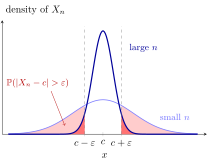
The figure shows the density of for a small and a large , both centred at , with the band from to marked. The shaded area outside the band is , and it is much smaller for the narrow large- density. Convergence in probability to means that this area tends to as , however narrow the band is chosen.
Here and . Pick any : the probability of an error larger than tends to , which is exactly the definition.
Two steps are involved: first is fixed, then the limit of the numbers is taken. Small errors are allowed at every ; only the probability of errors above the tolerance must vanish. Most uses have a constant limit, as in the weak law of large numbers. A quick proof for a constant limit uses the Chebyshev inequality: if and , then .
A common slip is to conclude that expectations converge as well. If with probability and otherwise, then , yet for every : a rare but large error does not count in the definition. The stronger almost-sure convergence additionally requires almost every path to converge.
Key Results
- Almost-sure convergence implies convergence in probability.
- Convergence in probability implies convergence in distribution; the converses generally fail.
Examples
- If , then for every , for sufficiently large , so .
- If , then for , .
Prerequisites
Related Concepts
Sources
- Nicky van Foreest · Probability Distributions · Week 7
Keywords: convergence in probability to a constant, stochastic convergence Symbols: epsilon, infinity, mu
Last updated: 20 October 2026 03:02
Convergence in ProbabilityWeak Law of Large NumbersRandom VariableSequenceLimit of a SequencePointwise ConvergenceAlmost-Sure ConvergenceConvergence in DistributionChebyshev Inequality