Gamma Distribution
Definition
For shape and rate , has density
The Gamma Function in the denominator normalizes the density: substituting makes the unnormalized integral equal to , which cancels the denominator.
Interpretation
The gamma family extends exponential waiting times. For a positive integer shape , is the distribution of a sum of independent waits, for example the time until the -th arrival in a Poisson process with rate .
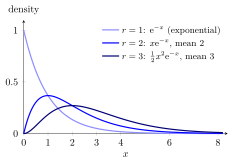
The figure shows three densities with rate . For the density on is the exponential one, , with right-hand limit as . The displayed version sets , so its supremum is approached rather than attained; changing a density at a single point does not change the distribution. For and the factor pushes the density down to at the origin, giving a hump with its peak at . The means and move to the right, and the spread grows with the variance .
Change the shape and the rate . At the density is ; integer gives the waiting time for exponential events.
The shape sets the form of the density through the power , and the rate only sets the scale: if , then . Non-integer shapes are allowed because the gamma function normalizes the density for every ; they no longer count exponential waits, but the formulas for mean, variance and MGF stay the same.
The MGF is the -th power of the exponential MGF, so the MGF of an independent sum and MGF uniqueness prove the sum property. The same argument shows that independent and variables add to , provided the rates agree. Some texts use a scale parameter instead, with mean ; check the convention before using a formula.
Key Results
- In shape-rate notation, and .
- for ; shape gives the exponential law.
Examples
- For shape and rate , the density is on , the mean is , and the variance is .
- The sum of three independent waits has distribution, with mean and variance .
Prerequisites
Related Concepts
Sources
- Probability Distributions · supporting concept
Keywords: Erlang distribution Symbols: gamma, lambda, theta
Last updated: 27 October 2026 11:52
Gamma DistributionProbability Density FunctionGamma FunctionMGF of an Independent SumExponential DistributionConvolution of Independent Random Variables