Strong Law of Large Numbers
Theorem
Let be i.i.d. with and mean . Then the sample mean satisfies
The i.i.d. assumption gives one common integrable law and independence. The conclusion is Almost-Sure Convergence: outside one probability-zero exceptional set, the entire sequence of sample averages tends to .
Interpretation
The running average of an integrable i.i.d. sequence settles at the population mean with probability one. Fix one outcome and follow the whole sequence of averages : for almost every outcome this sequence of numbers converges to .
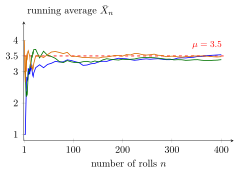
The figure shows three simulated sequences of fair die rolls, so . Each line is one sample path . Early on the paths wander, because a single roll still moves the average noticeably: after the first roll the three averages are , and . After a few hundred rolls each path stays close to . The strong law says that on almost every path the average does not only come close but converges to .
Each path is one sequence of draws. Almost every path eventually enters the band and stays there; show more steps or narrow the band to test it.
The hypotheses are an i.i.d. sequence and ; finite variance is not needed, as the second Example shows. Independence cannot simply be dropped: if every equals the first die roll , the variables are identically distributed but for every , which never approaches . Without a finite mean there is no to converge to.
Almost-sure convergence implies convergence in probability, so the strong law implies the weak law. Applied to indicators of independent repetitions of an experiment, it says that the relative frequency of converges to almost surely. This justifies reading probabilities as long-run frequencies.
Key Results
- Finite is sufficient; finite variance is not required.
- The almost-sure conclusion also implies .
Examples
- For i.i.d. fair die rolls, the running average converges almost surely to .
- For i.i.d. variables with density for and zero elsewhere, the mean is and the second moment is infinite; the running average still converges almost surely to .
Prerequisites
- Independent and Identically Distributed Random Variables
- Sample Mean
- Expectation
- Almost-Sure Convergence
Related Concepts
Sources
- Nicky van Foreest · Probability Distributions · Week 7
Aliases: SLLN, strong law, Kolmogorov's strong law Symbols: epsilon, infinity, mu, sum
Last updated: 20 October 2026 03:02
Strong Law of Large NumbersIndependent and Identically Distributed Random VariablesSample MeanExpectationAlmost-Sure ConvergenceWeak Law of Large NumbersCentral Limit TheoremAlmost Surely