Convergence in Distribution
Definition
A sequence of random variables converges in distribution to if the CDFs of the converge to the CDF of wherever the latter is continuous:
for every point at which is continuous. This is written as . Convergence at the jump points of is not required, and the variables may be defined on different probability spaces (different sample spaces with their own probability functions), because only their CDFs are compared.
For each continuity point of the limiting CDF, take an ordinary Limit of a Sequence of numbers . The input stays fixed while the random-variable index grows.
Interpretation
Convergence in distribution says that probabilities computed from approach those computed from : for large . Only the distributions are compared, through their CDFs; the values of need not approach the values of along any sample path.
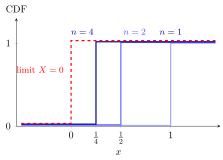
The figure shows the CDFs of the constants for , each a step from to at . The steps move towards the step at of the limit , so for every . At the jump point itself, for every while .
Raise and watch the CDF of close in on . For a discrete start the CDF keeps its jumps, yet the largest gap still shrinks.
This example explains why the definition only asks for convergence where is continuous. The numbers certainly approach , and any reasonable notion of convergence should allow it; demanding convergence at the jump as well would exclude this example. For a continuous limit such as every point is a continuity point, so the CDFs must converge everywhere, which is the form used in the central limit theorem.
Convergence in distribution is the weakest of the three modes of convergence on these pages. In the second Example, has the law of for every , so it converges in distribution to , yet keeps switching between and . A statement therefore says nothing about being small, except when the limit is a constant, where it implies convergence in probability.
Key Results
- Convergence in probability implies convergence in distribution.
- Convergence in distribution to a constant implies convergence in probability to .
Examples
- If , its CDF converges to the CDF of the constant at every continuity point , so .
- For and , every has the law of , so , but does not converge in probability to : odd-index differences are .
Prerequisites
Related Concepts
Sources
- Nicky van Foreest · Probability Distributions · Week 8
Aliases: convergence in law, weak convergence, distributional convergence Symbols: phi
Last updated: 20 October 2026 03:02
Convergence in DistributionCentral Limit TheoremCumulative Distribution FunctionLimit of a SequenceConvergence in Probability