Poisson Merging
Theorem
If and are independent, then . Independence is needed: Poisson marginals alone do not make the sum Poisson.
The Poisson Distribution has MGF . Multiplying the MGFs of the independent counts adds their parameters, identifying the law of the total.
Interpretation
Independent Poisson sources combine into a Poisson total whose parameter is the sum of the source parameters. Counting two independent streams of events together gives a count of the same kind, with the means added.
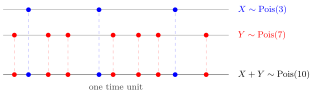
Over one time unit, the blue arrivals form a count and the red arrivals an independent count. Placing both on one line gives the merged count ; in this sample there are arrivals. The merged line no longer records which source an arrival came from.
Two independent Poisson sources together give .
The proof is a short MGF computation: multiplying the MGFs gives , and uniqueness identifies . A direct check sums over the ways to split a total into and ; the binomial theorem then gives
Independence is essential. If and , both counts are Poisson, but takes only even values, so it is not Poisson. Merging and Poisson splitting describe the same situation from two sides: given the total , each of the items comes from the first source with probability , independently, which is the binomial statement in the Key Results.
Key Results
- For finitely many independent Poisson variables, .
- For and as in the theorem, .
Examples
- Independent arrival counts with means and combine to a count.
- Two independent counts with means and have total-zero probability .
Prerequisites
Related Concepts
Sources
- Nicky van Foreest · Probability Distributions · Week 1
Aliases: sum of independent Poisson random variables Symbols: lambda, sum
Last updated: 20 October 2026 03:02
Poisson MergingPoisson DistributionIndependent Random VariablesMGF of an Independent SumChicken–Egg TheoremPoisson Splitting