Two-Dimensional LOTUS for Discrete Variables
Theorem
For a discrete pair and a function with ,
For the formula also holds without this assumption, as an extended (possibly infinite) expectation.
Interpretation
A function of two variables can be averaged directly using their joint PMF, even when the variables are dependent: each pair contributes the value times its mass. There is no need to work out the distribution of first.
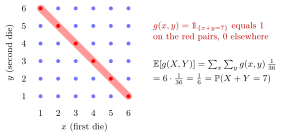
For two fair dice, take if and otherwise, the indicator of the event . It equals on the six red pairs of the anti-diagonal and on the other pairs. Each pair has mass , so , which is : the expectation of an indicator is the probability of its event.
This is LOTUS with the pair in place of a single variable, so the weights are joint masses, not the two marginal PMFs. The difference matters: for , , while for independent fair Bernoulli variables, with the same marginals, . The summability condition guarantees that the double sum has the same finite value in any order of summation.
Choosing gives familiar rules. With the double sum splits into , which is linearity of expectation, , without any independence assumption, provided both means exist. For independent and the joint PMF factorizes, and gives . The continuous version replaces the sums by an integral against a joint density.
Key Results
- Choosing gives .
- Choosing gives .
Examples
- For independent fair Bernoulli variables, .
- For independent fair dice, .
Prerequisites
Related Concepts
Sources
- Nicky van Foreest · Probability Distributions · Week 1
Keywords: LOTUS Symbols: infinity, sum
Last updated: 20 October 2026 03:02
Two-Dimensional LOTUS for Discrete VariablesJoint Probability Mass FunctionExpectationLOTUSTwo-Dimensional LOTUS for Continuous VariablesCovariance