Chernoff Bound
Theorem
Let be a random variable and . For every at which the MGF is finite,
Optimizing over such gives the tightest bound. The optimization must stay within the region where the MGF is finite, and the infimum need not be attained.
Apply the Generalized Markov Inequality to the nonnegative variable at threshold . Its expectation is the Moment Generating Function , giving the displayed bound.
Interpretation
An exponential transformation turns a tail probability into an MGF bound. For a fixed with , the bound decreases exponentially in the threshold , whereas the Markov and Chebyshev bounds decrease only like and .
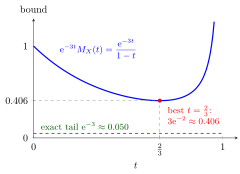
The figure plots the bound for and , the second Example. Every gives a valid bound. The curve starts at for and grows without bound as , where the MGF stops being finite. Its minimum, at , is , still well above the exact tail .
Every gives a bound (right). Move , or press the button, to find the that makes it smallest.
The free parameter is a trade-off: larger makes smaller but larger. Setting the derivative of to zero gives the best in both Examples. Only is allowed in the upper-tail bound, because the Markov step needs a nondecreasing function; for the function is decreasing, and the same argument bounds the lower tail instead.
The bound is at its strongest for sums. For i.i.d. terms, the MGF of an independent sum gives . When the bracket is below , which a small achieves for if the MGF is finite near , the bound falls exponentially in , much faster than the Chebyshev bound, which decreases like .
Key Results
- .
- For with finite MGF, .
Examples
- For and , choose : .
- For and , choose : .
Prerequisites
Related Concepts
Sources
- Nicky van Foreest · Probability Distributions · Week 7
Aliases: Chernoff inequality, Chernoff's bound, Cramér–Chernoff bound Symbols: element of, infinity, real numbers
Last updated: 20 October 2026 03:02
Chernoff BoundGeneralized Markov InequalityMoment Generating FunctionMGF of an Independent SumChebyshev Inequality