Conditional Variance Given a Random Variable
Definition
For , conditional variance is
These identities hold almost surely.
Apply the definition of Variance and Standard Deviation within the law conditional on : subtract the Conditional Expectation Given a Random Variable and average its squared residual under that same conditional law.
Interpretation
Conditional variance measures how much spread in remains once the value of is known. Like the conditional expectation , it is itself a random variable: a function of , not a single number.
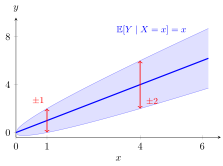
The diagram shows . The band around the conditional mean line has half-width : at and at , so larger gives more spread. Evaluating at the random gives the random variable , as in the first Example.
is the spread within group (right); averaged over it gives .
Read the definition in two steps. First fix and compute an ordinary variance under the conditional distribution of given : for discrete this is the conditional variance given the event , a number ; for continuous the conditional PDF takes over this role. Then substitute the random to get . The squared deviations are measured from , the centre of each group, not from the overall mean . The second formula is the familiar "mean of the square minus square of the mean", applied inside the conditional distribution.
Averaging over gives , the within-group part of Eve's law. A common slip is to expect : this misses the spread of the group centres themselves, .
Key Results
- almost surely.
- For real constants , .
Examples
- If with , then .
- If with , then .
Prerequisites
Related Concepts
Sources
- Nicky van Foreest · Probability Distributions · Week 6
Symbols: infinity, square root
Last updated: 22 October 2026 19:04
Conditional Variance Given a Random VariableEve’s Law: Total VarianceConditional Expectation Given a Random VariableVariance and Standard DeviationConditioning Trick for Variance