Total Probability with Extra Conditioning
Theorem
Let be an event with and a finite or countable partition, and write for . Then, omitting the terms with ,
Analogous versions hold for expectations, PMFs, and PDFs.
Apply the Law of Total Probability within the probability law conditional on . Its case weights are rather than the unconditional weights.
Interpretation
Case-by-case probability calculations remain valid after some background information is fixed. Conditioning on gives a new probability function , and the ordinary law of total probability holds for it as for any other.
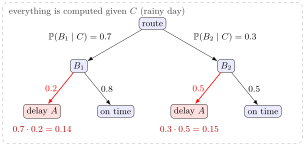
The tree in the figure lies entirely inside the box "given ". The first branches carry the case weights and , the second branches the delay probabilities and . Multiplying along the two delay paths gives and , and adding them gives , as in the first Example.
Both factors in each term must carry . The weights can differ from the unconditional : on rainy days a traveller may choose route more often than usual. Likewise is the delay probability on that route on a rainy day, not on an average day. Mixing the two, as in , is the typical slip; it is a valid rule only when every is independent of , so that .
The same pattern extends to the other conditioning rules: Bayes' rule with added to every term reads , and the version for expectations is Adam's law with extra conditioning.
Key Results
- .
- Only cases with need conditional probabilities .
Examples
- Within known rainy days , suppose , with delay probabilities and in the two routes. Then .
- For a fair die conditioned to be even, partition into and . Then .
Prerequisites
Related Concepts
Sources
- Nicky van Foreest · Probability Distributions · Week 6
Aliases: LOTP with extra conditioning, conditional law of total probability Symbols: intersection, sum
Last updated: 20 October 2026 03:02
Total Probability with Extra ConditioningLaw of Total ProbabilityConditional ProbabilityAdam’s Law with Extra Conditioning