Continuity Correction
Method
When approximating for an integer-valued random variable by a normal distribution with mean and standard deviation , use
(and similarly for ). The half-unit shift is an approximation rule, not an exact identity.
Here is the CDF of the Standard Normal Distribution. Subtracting and dividing by converts the shifted boundary to its standard-normal scale.
Interpretation
An integer-valued probability is a sum of bar heights, and the bar for the value has width and covers . A normal area approximates those bars best when it covers the same half-unit cells around the included integers.
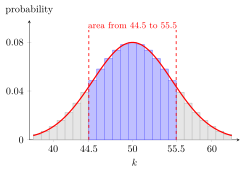
The figure shows with the density. The highlighted bars together cover , so the normal area is taken between these endpoints: , which agrees with the exact value to four decimals. Without the correction, leaves out half of each end bar.
The bars for end at , not at . Compare both normal answers with the exact probability.
The direction of the shift depends on which integers the event includes. includes the bar at , so the area ends at ; ends at ; starts at . Write the event as a range of integers first, then extend it by half a unit at both ends. For a single value, the uncorrected normal answer to would be , while the corrected one uses the width of the bar, as in the first Example.
The correction matters most when is small, because half a unit is then a large fraction of a standard deviation. It is used with the normal approximation to the binomial and, more generally, with the central limit theorem for integer-valued sums such as totals of die rolls.
Key Results
- .
- For integers , .
Examples
- For , .
- For the same , .
Prerequisites
Related Concepts
Sources
- Nicky van Foreest · Probability Distributions · Week 8
Aliases: correction for continuity Symbols: mu, phi, sigma
Last updated: 20 October 2026 03:02
Continuity CorrectionStandard Normal DistributionCentral Limit TheoremNormal Approximation to the Binomial