MGF of an Independent Sum
Theorem
If and are independent (), then for every at which both MGFs are finite,
Independence is essential.
Use the Moment Generating Function definition to write . Independence factors this expectation into the two MGFs.
Interpretation
Adding independent variables corresponds to multiplying their MGFs. Since an MGF that is finite near zero determines the distribution, this often identifies the distribution of a sum directly, without working out its PMF or density value by value.
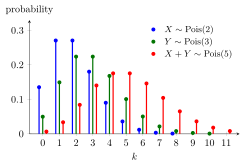
The figure shows , an independent and their sum, which lies further right and is more spread out. Multiplying the Poisson MGFs gives , the MGF of , so by uniqueness the sum is .
For independent and the MGF of is the product of the two curves, which identifies the distribution of the sum.
The product comes from : for independent and the factors and are independent, and the expectation of a product of independent variables is the product of the expectations. Without independence this step fails. For with , the sum has MGF , whereas ; the difference is , which is positive for every .
For i.i.d. variables the product becomes a power. Thus independent variables give , the MGF of the binomial distribution, and independent variables give for , the MGF of the gamma distribution with shape and rate .
Key Results
- For independent , .
- For i.i.d. variables, .
Examples
- The sum of independent Poisson variables with parameters and has MGF , so it is .
- The sum of two independent variables has MGF for , identifying in rate notation.
Prerequisites
Related Concepts
- Uniqueness of Moment Generating Functions
- Poisson Merging
- Convolution of Independent Random Variables
- Gamma Distribution
- Chernoff Bound
Sources
- Nicky van Foreest · Probability Distributions · Week 1
Aliases: MGF of a sum of independent random variables, moment generating function of an independent sum Symbols: lambda, product, sum
Last updated: 20 October 2026 19:41
MGF of an Independent SumCumulant Generating FunctionMoment Generating FunctionIndependent Random VariablesUniqueness of Moment Generating FunctionsPoisson MergingConvolution of Independent Random VariablesGamma DistributionChernoff Bound