Almost-Sure Convergence
Definition
Let and be random variables defined on one probability space, that is, one sample space with one probability function. The sequence converges almost surely to if
The set of outcomes on which does not converge to need not be empty, but it must have probability zero. This is written as . One also says that converges to with probability one, abbreviated w.p.1.
For each outcome outside the exceptional null set, the Limit of a Sequence is taken for the numerical values ; the probability-one condition refers to the set of outcomes where that limit equals .
Interpretation
Almost-sure convergence looks at one outcome at a time. For a fixed outcome, is an ordinary sequence of numbers, the sample path of that outcome, and the question is whether it tends to the value of . Outside a set of outcomes of probability zero, the answer must be yes: this is pointwise convergence on the sample space, with a negligible exceptional set allowed.
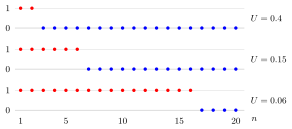
The figure follows from the second Example for the three outcomes , and . Each path equals while and from then on: the last occurs at , and respectively. Smaller drops later, but every outcome with eventually reaches and stays there. The only exception, , has probability zero, so .
Almost-sure convergence is about whole paths: each simulated path of settles at . The red dot marks the last time a path leaves the band.
The word "almost" allows that exceptional set; see almost surely. The probability in the definition is taken once, for the set of outcomes whose whole path converges, not separately for each . That is the difference with convergence in probability, which only asks that be small for each large and still allows the paths to keep making occasional large errors forever. Almost-sure convergence is the stronger of the two, and it is the mode of convergence in the strong law of large numbers.
Key Results
- Almost-sure convergence implies convergence in probability.
- Changing any of the variables on a common event of probability zero does not change almost-sure convergence.
Examples
- If is finite almost surely and , then on every outcome where is finite, so convergence is almost sure.
- For a single and , each outcome with eventually has , so almost surely.
Prerequisites
Related Concepts
Sources
- Nicky van Foreest · Probability Distributions · Week 7
Aliases: almost sure convergence, convergence with probability one, convergence almost surely, convergence with probability 1 Keywords: a.s. convergence Symbols: epsilon, infinity, mu, omega
Last updated: 20 October 2026 03:02
Almost-Sure ConvergenceStrong Law of Large NumbersRandom VariableLimit of a SequenceAlmost SurelyConvergence in Probability