Axioms of Probability
Axiom
Let be a sample space, let be a sigma-algebra of events, that is, a collection of events containing and closed under complements and countable unions, and let . The function satisfies the axioms of probability if:
- for every event .
- .
- If are pairwise disjoint events, then
Interpretation
The axioms are the minimal rules that every assignment of probabilities must obey: probabilities are never negative, the whole sample space has probability one, and probabilities of disjoint events add up. Every other rule, such as the complement rule in the Key Results, follows from them.
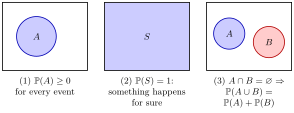
The three panels match the three axioms. An event inside gets a number ; the whole of gets , since some outcome is always realized; and two events and without overlap give . The figure draws axiom 3 for two events, while the axiom asks it for any sequence of pairwise disjoint events.
The first two axioms fix the scale: with additivity they give , so no probability exceeds . Additivity needs disjointness: on a fair die , but , because the outcome is counted twice. Countably many events are needed for infinite sample spaces: when a fair coin is tossed until the first head, "a head eventually appears" is the disjoint union of "first head at toss " for , with probability , a geometric series.
The axioms do not say which probabilities fit a given experiment. "All outcomes equally likely", as in naive probability, is an extra modelling assumption that satisfies them. A function that satisfies the axioms is called a probability function.
Key Results
- From the axioms, for every event .
- If , then .
- Finite additivity follows from countable additivity: for pairwise disjoint take in axiom 3 and use , which gives .
Examples
- In a fair die model, nonnegativity assigns no negative chance to any face, and the sample space has probability one.
- If the events 'roll a one' and 'roll a two' are disjoint, their union has probability equal to the sum of their probabilities.
- For nested events such as 'roll at most two' and 'roll at most four', monotonicity gives the smaller event no larger probability.
Prerequisites
Related Concepts
- Naive Probability
- Conditional Probability
- Complement of an Event
- Union and Intersection of Events
- Set
Sources
- Probability Theory for EOR · Week 1
Aliases: Kolmogorov axioms, probability axioms, axioms of Kolmogorov, axiomatic definition of probability Symbols: infinity, real numbers, subset, sum, union
Last updated: 20 October 2026 03:02
Axioms of ProbabilityProbability FunctionSample SpaceEventDisjoint EventsNaive ProbabilityConditional ProbabilityComplement of an EventUnion and Intersection of EventsSet