Folded Normal Distribution
Definition
Let be a normally distributed random variable. The random variable has a folded normal distribution.
Interpretation
A folded normal distribution is obtained by reflecting negative normal values to the positive side. It is useful when only the magnitude of a normally distributed quantity matters.
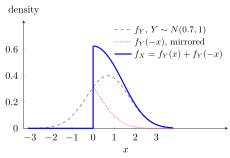
The illustrated calculation gives . The sign is lost, so the density of on the negative side is folded onto the positive side and all mass lands on .
Move towards : more of the normal density of lies below zero and gets reflected, and the density of is the sum of the two dashed curves.
The normal distribution supplies the original variable . Folding by absolute value combines the probability near a positive value with the probability near its negative, giving a nonnegative transformed variable.
Key Results
- A folded normal variable is the absolute value of a normal variable.
- Its support is nonnegative.
- When the underlying normal mean is zero, it is called a half-normal distribution: then has density for .
Examples
- The absolute measurement error from a normally distributed error has a folded normal distribution.
- The distance from zero of a one-dimensional normal displacement is folded normal.
- Quality-control deviations recorded only by magnitude can follow a folded normal model.
Prerequisites
Related Concepts
Sources
- Probability Theory for EOR · Week 5
Aliases: folded Gaussian distribution Keywords: distribution of the absolute value of a normal random variable Symbols: infinity, mu
Last updated: 20 October 2026 03:02
Folded Normal DistributionNormal DistributionAbsolute ValueTransformation of a Continuous Random VariableFunction of a Random Variable