Order Statistic
Definition
Let be random variables and let be the ordered values. The random variable is called the th order statistic.
Interpretation
Order statistics describe a sample by rank rather than by the order in which the values were drawn: is the th smallest value. The most used ones are the minimum , the maximum and, for odd , the sample median.
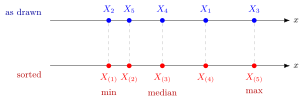
The upper row shows five values in the order in which they were drawn; the lower row shows the same five points renamed by rank. No point moves: the minimum is , the median is and the maximum is . Which draw gets which rank varies from run to run, so each is a random variable.
Sort a uniform sample and pick the th smallest. Over many samples clusters around : the minimum near , the maximum near .
Even when are i.i.d., the order statistics are neither independent nor identically distributed, since always holds. The extremes are still easy to handle through the CDF of one observation: the maximum is at most exactly when every observation is, and the minimum exceeds exactly when every observation does, so independence gives
A middle order statistic needs a counting argument instead: means that at least of the observations are at most , and the number of such observations has the binomial distribution with parameters and .
The brackets matter: is the th smallest value, while is the th draw. For exponential observations the minimum formula returns as the minimum of independent exponentials.
Key Results
- The first order statistic is the sample minimum and the last is the sample maximum.
- Order statistics are functions of a sample.
- They are central in quantile estimation and reliability calculations.
Examples
- The smallest of five component lifetimes is the first order statistic.
- The median of a sample of odd size is the middle order statistic ; for it is .
- The maximum daily demand in a month is the largest order statistic of the daily demands.
Prerequisites
- Random Variable
- Independent and Identically Distributed Random Variables
- Cumulative Distribution Function
Related Concepts
Sources
- Probability Theory for EOR · Week 5
- Game Theory · Week 6 (revisited)
Aliases: order statistics Keywords: maximum of iid uniforms, sample maximum
Last updated: 22 October 2026 19:04
Order StatisticDensity of an Order StatisticFirst-Price AuctionRevenue Equivalence TheoremSecond-Price AuctionWinner's CurseRandom VariableIndependent and Identically Distributed Random VariablesCumulative Distribution FunctionQuantile FunctionMinimum of Independent ExponentialsProbability Density FunctionRandom Interval