Poisson Process
Definition
Let . A process with , in which counts the arrivals in , is a Poisson process with rate if it has independent increments (arrival counts in disjoint time intervals are independent) and
for all .
Interpretation
A Poisson process models random arrivals over time. It assumes arrivals occur independently and at a constant average rate.
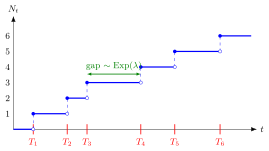
The count records arrivals in . For a Poisson process of rate , and disjoint increments are independent. The interarrival times, that is, the waiting times between consecutive arrivals, are i.i.d. exponential variables, with expected arrivals per unit time.
Each press of the button draws new arrivals at rate . The number in the window varies from draw to draw like a variable.
A stochastic process consists of variables indexed by time. The Poisson distribution specifies each interval count, while independent random variables describe counts on disjoint intervals; both properties are needed to specify the process, not just its one-time law.
Key Results
- A Poisson process has independent increments.
- The number of arrivals in an interval depends only on the interval length.
- Interarrival times in a Poisson process are independent exponential random variables.
Examples
- Customer arrivals to a store can be approximated by a Poisson process during a stable period.
- Particle emissions from a radioactive source are often modelled as a Poisson process.
- Requests to a server may be modelled as a Poisson process over short intervals.
Prerequisites
Related Concepts
Sources
- Probability Theory for EOR · Week 6
Aliases: homogeneous Poisson process, Poisson arrival process Keywords: Poisson point process, Poisson arrivals, counting process Symbols: lambda
Last updated: 20 October 2026 03:02
Poisson ProcessArrival RateCompound Poisson ProcessStochastic ProcessPoisson DistributionIndependent Random VariablesExponential DistributionMemoryless PropertyMinimum of Independent ExponentialsPoisson Splitting