Median
Definition
Let be a random variable with distribution function . A median of is a real number such that
Interpretation
A median is a central value that splits the distribution into two halves. Unlike the mean, it depends only on the order of the values, not on how far out the extreme ones lie.
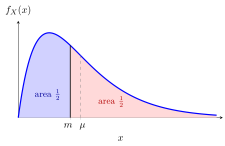
The density is for , with CDF . The solid line at , the solution of , cuts the area into two parts of each, and the dashed line marks the mean . The long right tail pulls the mean outwards but does not move the halfway point.
Move the candidate and check both conditions. For the skewed density the median is unique; for every is a median.
The Definition uses two inequalities rather than the equation , because that equation can have many solutions or none. For the CDF equals on all of , and every satisfies both conditions. For the CDF jumps from to at , so the equation has no solution, yet is the unique median. For a continuous, strictly increasing CDF the median is simply the quantile at level .
Because only the order of the values matters, medians move along with increasing transformations: if is a median of and is strictly increasing, then is a median of . This gives the median of the lognormal distribution. For a symmetric distribution, the centre of symmetry is a median.
Key Results
- A median need not be unique: the medians of a distribution form an interval, which contains more than one point exactly when the CDF equals on a whole stretch (for a fair die, every point of is a median). If the CDF jumps from below to above at a point, that point is the unique median.
- For a continuous strictly increasing CDF, the median is the point where the CDF equals one half.
- The median is robust to extreme values compared with the mean.
Examples
- The median of a symmetric normal distribution is its centre.
- For waiting times, the median is the time by which half of cases have occurred.
- In income data, the median can better describe a typical person than the mean when there are extreme high incomes.
Prerequisites
Related Concepts
Sources
- Probability Theory for EOR · Week 6
Aliases: 0.5-quantile, second quartile, 0.5 quantile, 50th percentile Keywords: median of a random variable Symbols: element of, mu
Last updated: 22 October 2026 19:04
MedianMedian Voter TheoremCumulative Distribution FunctionSymmetric DistributionQuantile FunctionSummary Measures of a Distribution